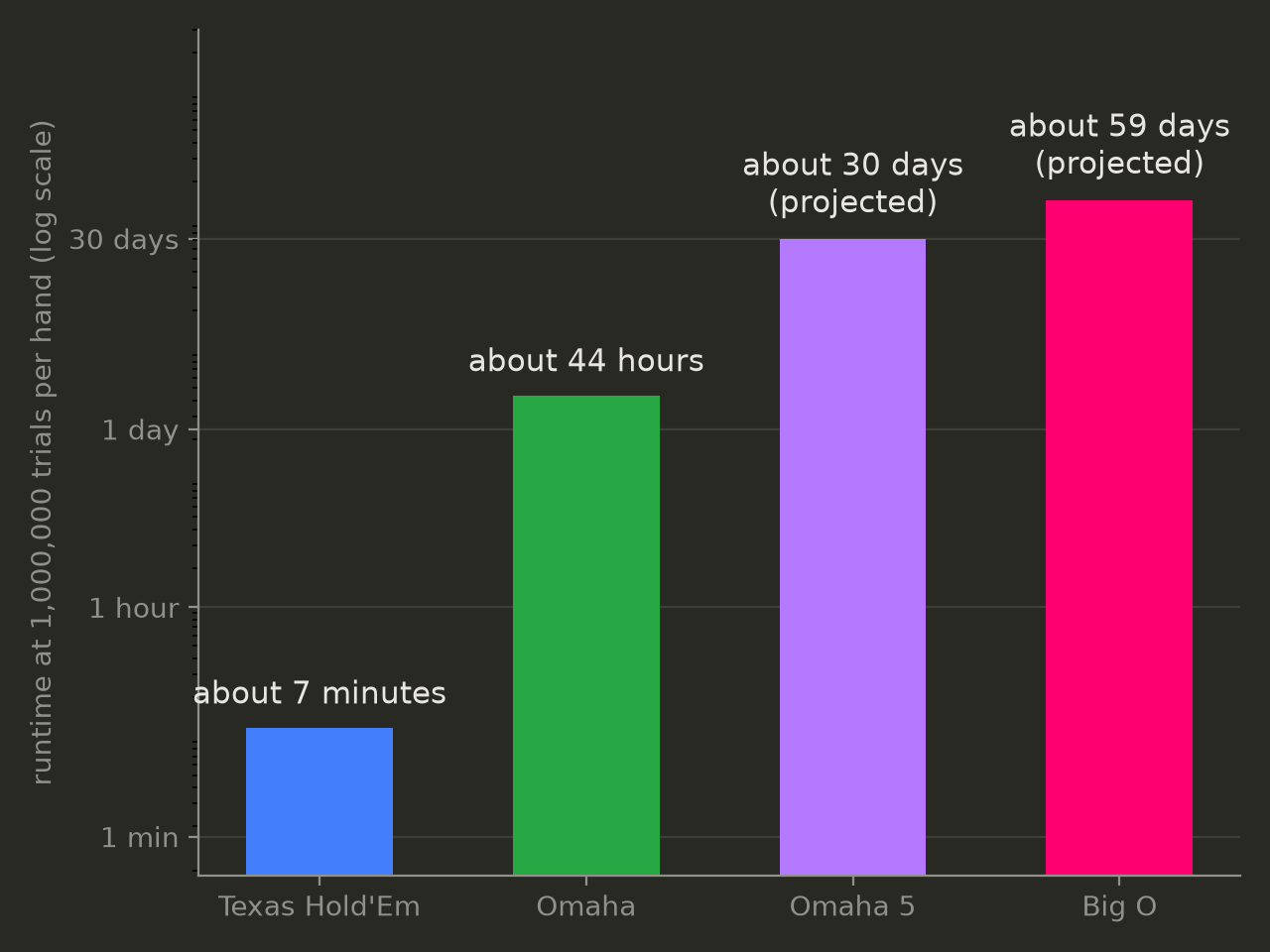
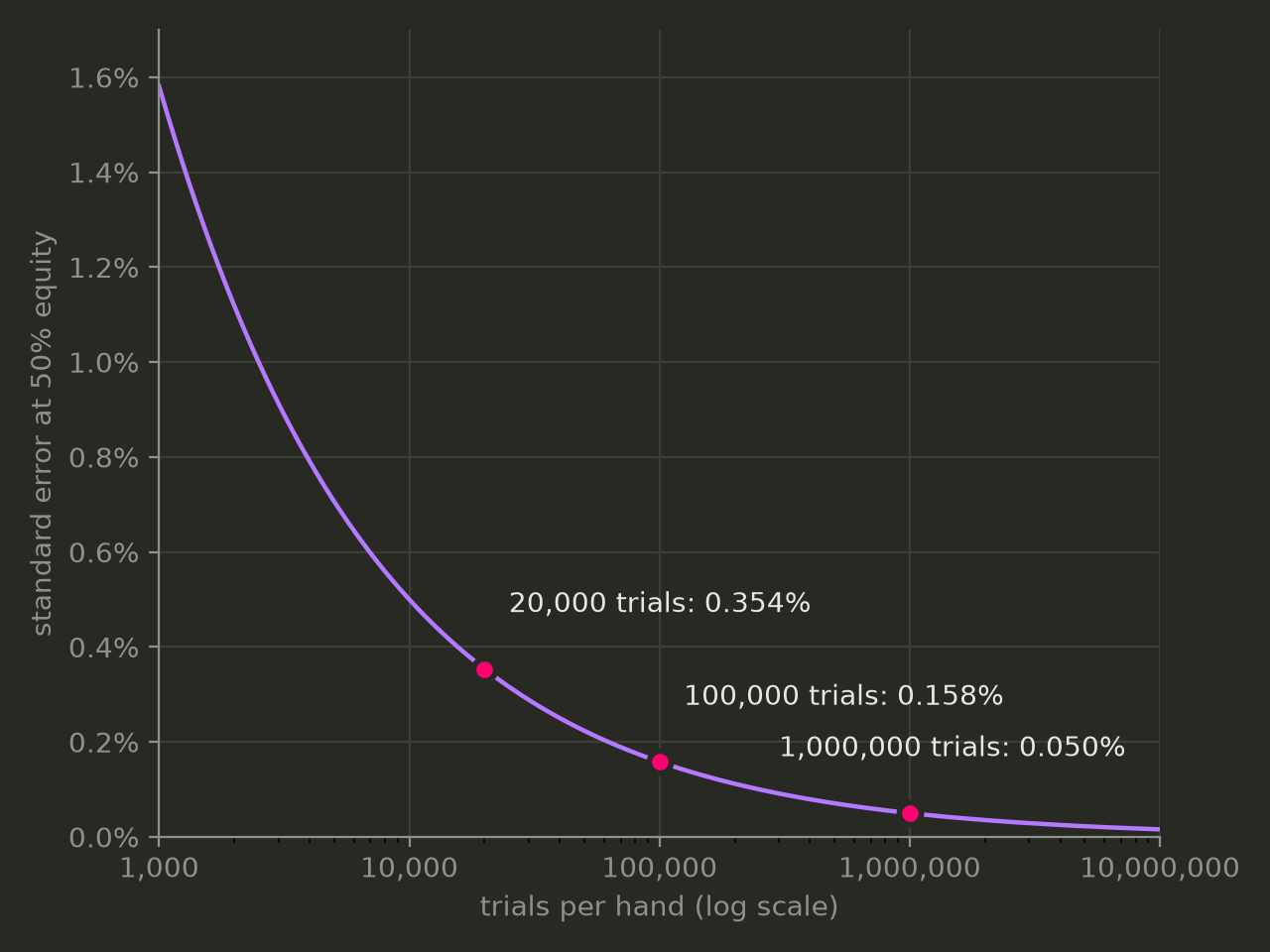
What the Simulator Does
Our preflop odds come from a Monte Carlo simulation. For each starting hand, the simulator deals a random opponent hand and a random five-card board from a freshly shuffled deck, finds each player's best five-card hand, and records a win, a tie or a loss. It repeats that 1,000,000 times for every starting hand in the game.
Three numbers decide how much work that takes: how many starting hands there are, how many trials each one gets, and how many five-card hands have to be evaluated in each trial.
Counting the Starting Hands
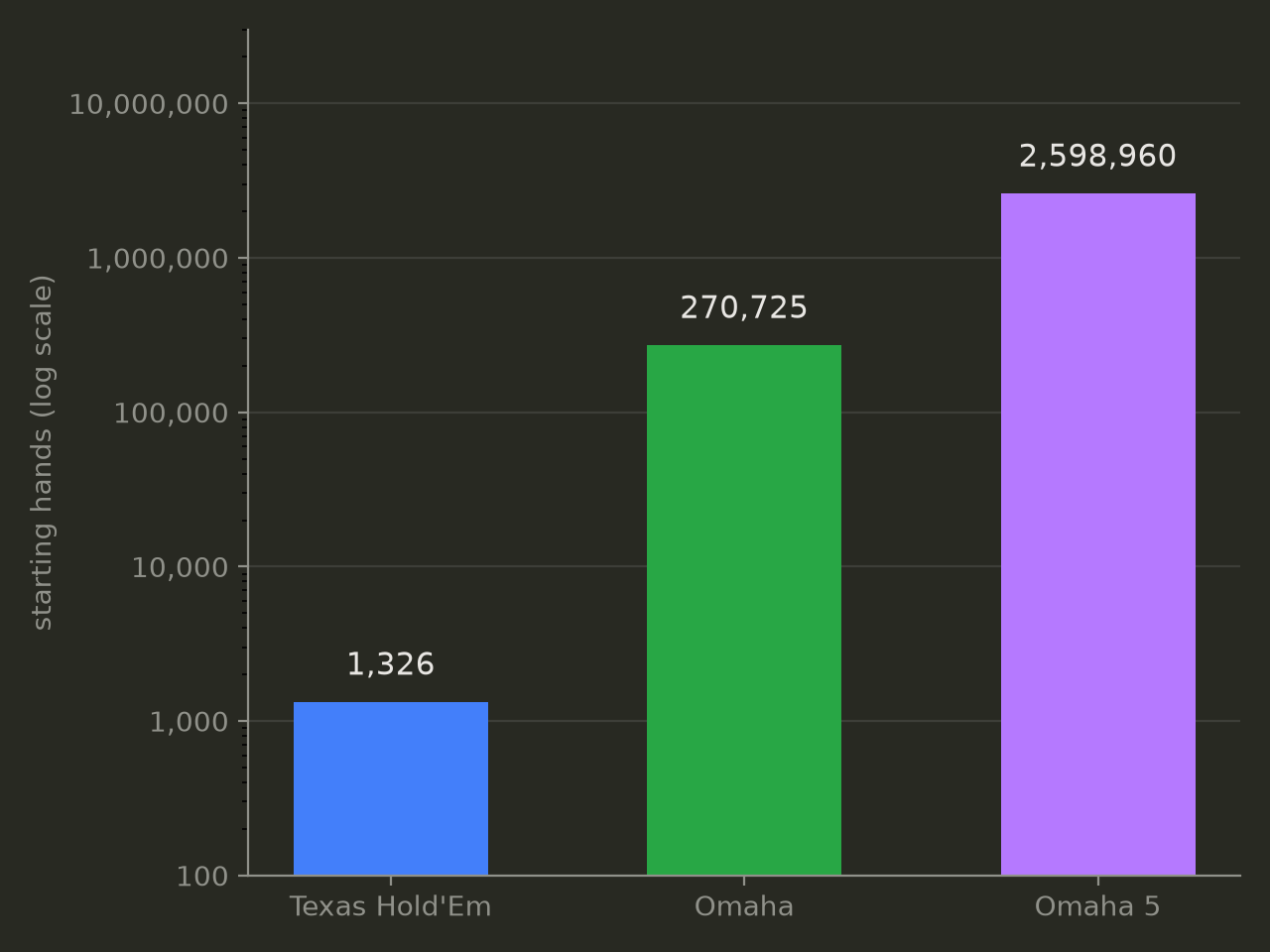
A starting hand of k cards from a 52-card deck can be dealt in C(52, k) = 52! / (k! (52 − k)!) ways. Each extra hole card multiplies the count:
| Game | Hole cards | Starting hands |
|---|---|---|
| Texas Hold'Em | 2 | 1,326 |
| Omaha | 4 | 270,725 |
| Omaha 5 | 5 | 2,598,960 |
For a fixed k, C(52, k) grows like 52k / k!: going from two hole cards to four multiplies the hands by about 204, and the fifth card multiplies them by 9.6 more. See Combinatorics for how these counts are built.
Hand Evaluations per Trial
In Hold'Em a player's best hand is any five of their seven cards, so each player has C(7, 5) = 21 hands to compare. In Omaha a player must use exactly two hole cards and three board cards, which gives C(4, 2) × C(5, 3) = 6 × 10 = 60 hands each. Five-card Omaha has C(5, 2) × C(5, 3) = 100. With two players in every trial:
| Game | Hands per player | Evaluations per trial |
|---|---|---|
| Texas Hold'Em | 21 | 42 |
| Omaha | 60 | 120 |
| Omaha 5 | 100 | 200 |
Each evaluation is a single table lookup: before the run, every one of the 2,598,960 possible five-card hands is ranked once and stored, so scoring a hand afterwards takes constant time, O(1).
Total Work in Big O
The total number of hand evaluations is W = H × T × E where H is the number of starting hands, T the trials per hand and E the evaluations per trial. For an Omaha-style game with k hole cards, E = 2 × C(k, 2) × C(5, 3), which grows like k2, so W = O(C(52, k) × T × k2)
| Game | H | T | E | Evaluations W |
|---|---|---|---|---|
| Texas Hold'Em | 1,326 | 1,000,000 | 42 | 5.6 × 10¹⁰ |
| Omaha | 270,725 | 1,000,000 | 120 | 3.2 × 10¹³ |
| Omaha 5 | 2,598,960 | 1,000,000 | 200 | 5.2 × 10¹⁴ |
| Big O | 2,598,960 | 1,000,000 | 400 | 1.0 × 10¹⁵ |
The work is linear in the number of trials and in the number of starting hands; the combinatorial growth lives entirely in H. Omaha takes about 580 times the work of Hold'Em, and five-card Omaha 16 times the work of Omaha.
So do all poker games have the same complexity? Big O notation can carry more than one variable, and here there are two that matter: T, the trials per hand, and H = C(52, k), the starting hands for k hole cards. The evaluations per trial, E, stay small (from 42 to 400), soW = O(H × T)Within a game, H is fixed and the work is O(T): every game is linear in its trials. Between games, the deck stays at 52 cards and what changes is k. Each extra hole card multiplies the starting hands by (52 − k) / (k + 1): 25.5 times going from one card to two, 16.7 from two to three, 12.25 from three to four and 9.6 from four to five.
Worked out with the real deck, as starting hands times evaluations per trial:Hold'Em: C(52, 2) × 42 = 1,326 × 42 = 55,692Omaha: C(52, 4) × 120 = 270,725 × 120 ≈ 3.2 × 10⁷Omaha 5: C(52, 5) × 200 = 2,598,960 × 200 ≈ 5.2 × 10⁸Big O: C(52, 5) × 400 = 2 × (Omaha 5) ≈ 1.0 × 10⁹Big O has the same starting hands as Omaha 5; playing Hi-Lo only doubles E. In Big O notation that factor of 2 is a constant and drops out, so both are O(C(52, 5) × T). The constant still matters in practice: it is the difference between about 30 and 59 days below.
| Game | Hole cards k | Starting hands H | Work per trial, H × E | vs Hold'Em |
|---|---|---|---|---|
| Texas Hold'Em | 2 | 1,326 | 55,692 | 1× |
| Omaha | 4 | 270,725 | 3.2 × 10⁷ | 583× |
| Omaha 5 | 5 | 2,598,960 | 5.2 × 10⁸ | 9,300× |
| Big O | 5 | 2,598,960 | 1.0 × 10⁹ | 18,700× |
Big O Notation
Big O describes how work grows with the size of a problem, ignoring constant factors. Formally, f(n) = O(g(n)) means there are constants c and n0 such that f(n) ≤ c × g(n) for every n ≥ n0 Big Theta, f(n) = Θ(g(n)), adds the matching lower bound: f grows exactly as fast as g, up to constants.
The growth rates that show up in poker odds:
| Growth | Example | Doubling the input |
|---|---|---|
| O(1) | Scoring a hand with the lookup table | same time |
| O(n) | Running n trials | twice the time |
| O(n2) | Comparing every hand with every other | four times |
| O(nk / k!) | C(n, k) for a fixed k | about 2k times |
| O(2n) | Every subset of n cards | squares the time |
On a full deck the gaps are enormous. At n = 52, O(n) is 52 steps and O(n2) is 2,704. C(52, 4) is 270,725, the number of Omaha starting hands, and 252 is about 4.5 × 10¹⁵. On a log scale a polynomial bends over while an exponential runs in a straight line: every card added doubles it.
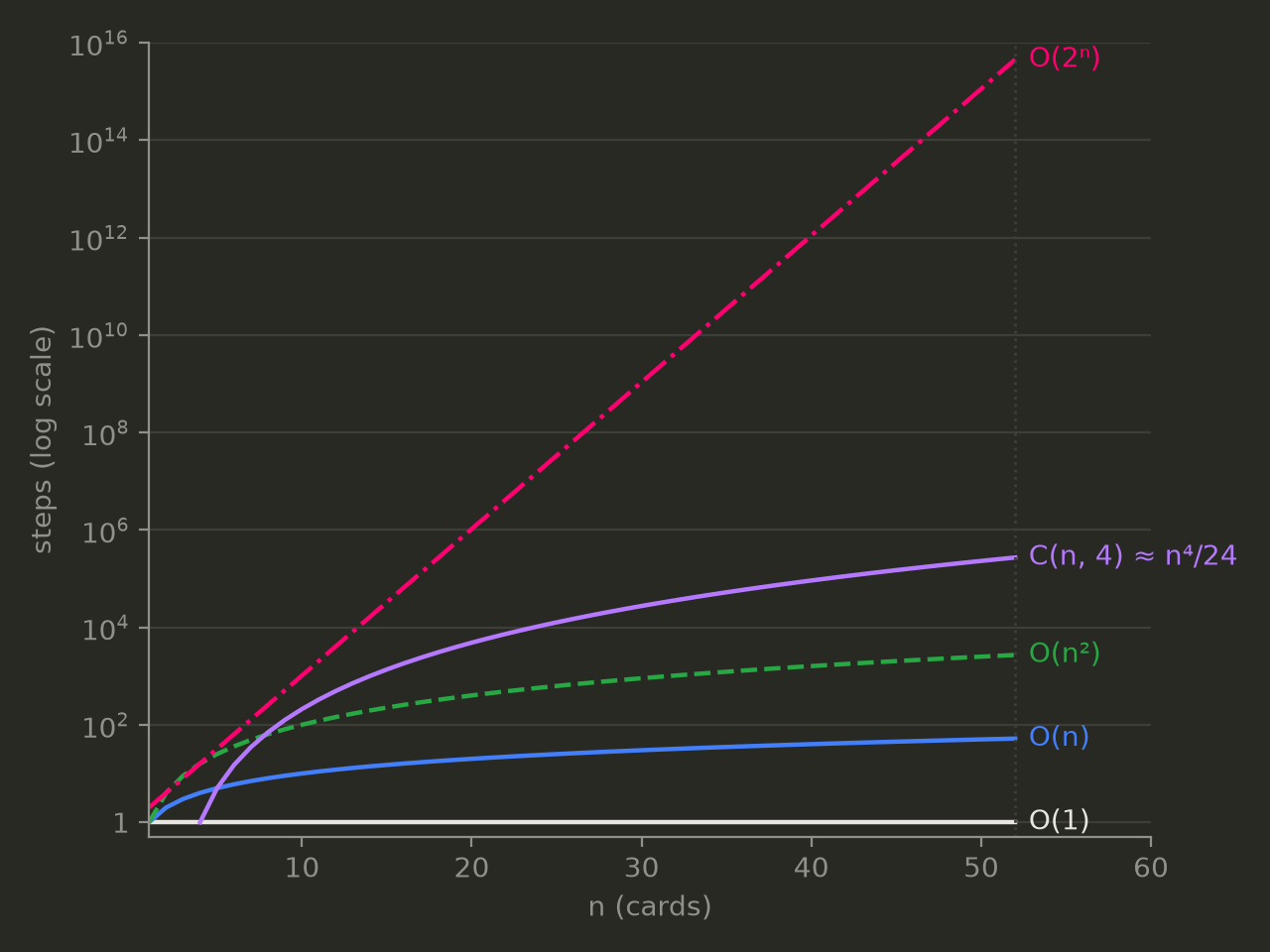
In poker the deck is always 52 cards, so the input that grows from game to game is the number of hole cards k. Through five cards, C(52, k) grows almost exponentially in k: each extra card multiplies the starting hands by roughly ten to twenty-five.