What Is Position in Poker?
Position is where you sit relative to the dealer button, and it decides the order in which you act. Preflop, the action starts left of the big blind; on every street after the flop, it starts left of the button, so the button acts last. Acting after your opponents is being in position; acting before them is being out of position.
Acting last is an information advantage. You see whether your opponents check, bet or raise before you decide, while they have to act without knowing what you'll do. Positional awareness is one of the biggest differences between amateur and professional players.
The Dealer Button
Every hand has a dealer button, a white disc marked D. In a casino a house dealer deals every hand, so the button marks who acts as the dealer for that hand. The two players to its left post the blinds: the small blind, then the big blind.
After each hand the button moves one seat to the left, clockwise, and the blinds move with it. Over a full orbit every player gets the button once and pays each blind once, so every position comes around to everyone.
Seat Numbers vs Positions
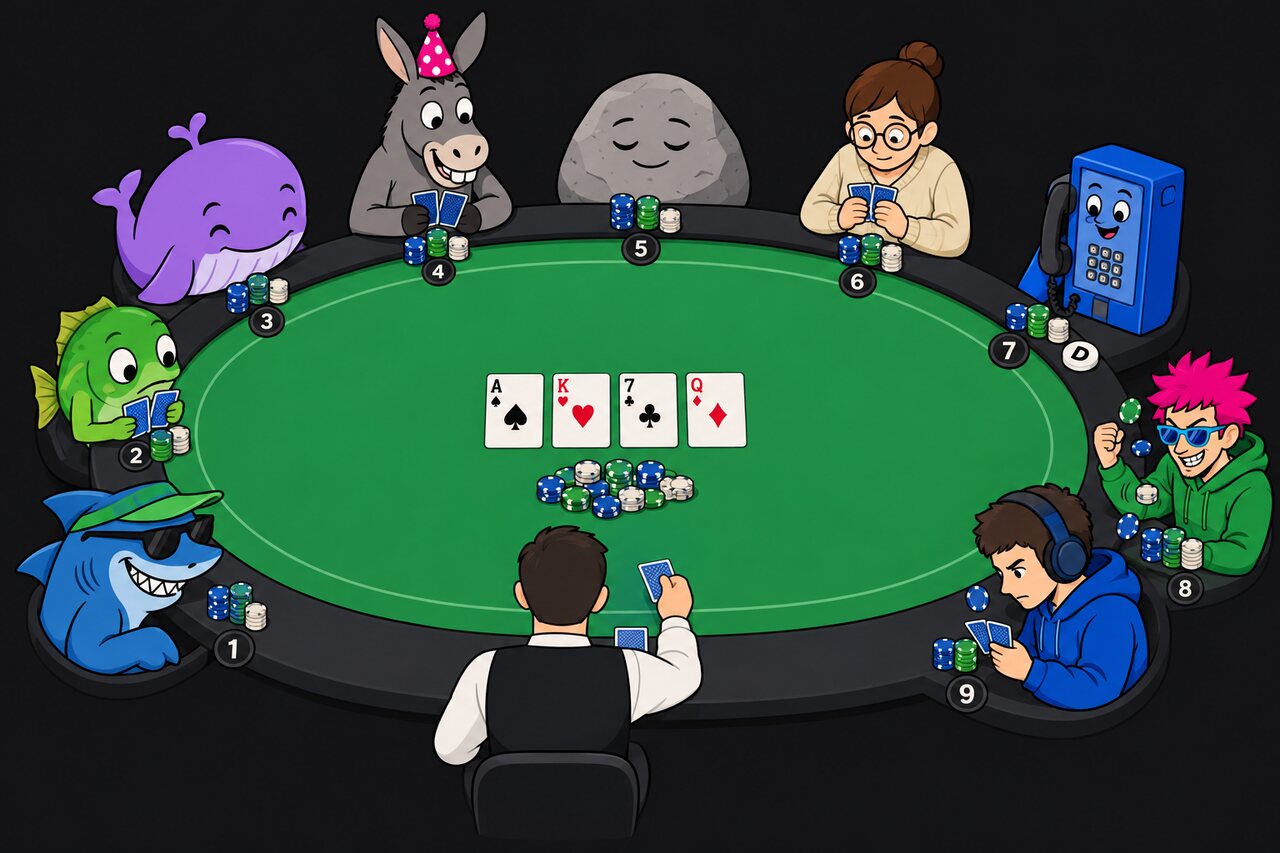
A seat number is a physical seat: in a casino, seat 1 is the first seat on the dealer's left, and the numbers run clockwise around the table to seat 9 or 10. Your seat number stays the same all session. A position, like UTG or the button, is relative: it is counted from the dealer button, so it changes every hand as the button moves.
In the picture above, the button is in seat 7. Seat 8 is the small blind, seat 9 the big blind, and the shark in seat 1 is under the gun. Next hand, the button moves to seat 8: now seat 9 is the small blind, seat 1 the big blind, and seat 2 is under the gun. The shark didn't move, but went from UTG to the big blind.
The Positions at the Table
The six seats of a 6-max table, in the order they act preflop. A full ring table adds more early and middle seats before the hijack: UTG+1, middle position (MP) and the lojack (LJ).
| Seat | Name | What it means |
|---|---|---|
| UTG | Under the Gun | First to act preflop, left of the big blind. The tightest seat: everyone else still acts after you. |
| HJ | Hijack | Two seats right of the button (the middle seats in a full ring game are MP, then LJ, the lojack, then HJ). |
| CO | Cutoff | Right of the button. Only the button and the blinds act after you preflop. |
| BTN | Button | The dealer. Acts last on every street after the flop: the best seat at the table. |
| SB | Small Blind | Posts half a blind and acts first on every street after the flop: the worst seat from which to play a pot. |
| BB | Big Blind | Posts a full blind and acts last preflop, but first-to-second after the flop. Defends wide because it already has money in the pot. |
Opening Ranges by Position
The closer you sit to the button, the fewer players are left to act behind you, and the more hands you can open profitably. Pick a seat to see a rough first-in opening range for 6-max No-Limit Hold'Em, as a share of all 1,326 starting combinations.
Each hand's equity against a random hand, from our simulations.
Hands ranked by preflop equity against a random hand. Percentages are of all 1,326 combinations.
| AA6 | AKs4 | AQs4 | AJs4 | ATs4 | A9s4 | A8s4 | A7s4 | A6s4 | A5s4 | A4s4 | A3s4 | A2s4 |
| AKo12 | KK6 | KQs4 | KJs4 | KTs4 | K9s4 | K8s4 | K7s4 | K6s4 | K5s4 | K4s4 | K3s4 | K2s4 |
| AQo12 | KQo12 | QQ6 | QJs4 | QTs4 | Q9s4 | Q8s4 | Q7s4 | Q6s4 | Q5s4 | Q4s4 | Q3s4 | Q2s4 |
| AJo12 | KJo12 | QJo12 | JJ6 | JTs4 | J9s4 | J8s4 | J7s4 | J6s4 | J5s4 | J4s4 | J3s4 | J2s4 |
| ATo12 | KTo12 | QTo12 | JTo12 | TT6 | T9s4 | T8s4 | T7s4 | T6s4 | T5s4 | T4s4 | T3s4 | T2s4 |
| A9o12 | K9o12 | Q9o12 | J9o12 | T9o12 | 996 | 98s4 | 97s4 | 96s4 | 95s4 | 94s4 | 93s4 | 92s4 |
| A8o12 | K8o12 | Q8o12 | J8o12 | T8o12 | 98o12 | 886 | 87s4 | 86s4 | 85s4 | 84s4 | 83s4 | 82s4 |
| A7o12 | K7o12 | Q7o12 | J7o12 | T7o12 | 97o12 | 87o12 | 776 | 76s4 | 75s4 | 74s4 | 73s4 | 72s4 |
| A6o12 | K6o12 | Q6o12 | J6o12 | T6o12 | 96o12 | 86o12 | 76o12 | 666 | 65s4 | 64s4 | 63s4 | 62s4 |
| A5o12 | K5o12 | Q5o12 | J5o12 | T5o12 | 95o12 | 85o12 | 75o12 | 65o12 | 556 | 54s4 | 53s4 | 52s4 |
| A4o12 | K4o12 | Q4o12 | J4o12 | T4o12 | 94o12 | 84o12 | 74o12 | 64o12 | 54o12 | 446 | 43s4 | 42s4 |
| A3o12 | K3o12 | Q3o12 | J3o12 | T3o12 | 93o12 | 83o12 | 73o12 | 63o12 | 53o12 | 43o12 | 336 | 32s4 |
| A2o12 | K2o12 | Q2o12 | J2o12 | T2o12 | 92o12 | 82o12 | 72o12 | 62o12 | 52o12 | 42o12 | 32o12 | 226 |
Pairs, on the diagonal: 13 × 6 = 78Suited, above it: 78 × 4 = 312Offsuit, below it: 78 × 12 = 936Total: 78 + 312 + 936 = 1,326 combinations
The chart ranks hands by equity against a random hand, from our simulations. Real opening charts also weigh how well a hand plays after the flop, so they include more suited connectors and fewer weak offsuit hands than a straight top-X% cut. The big blind doesn't open: it closes the action preflop and defends a wide range because it already has a blind in the pot.